Showing posts with label Let's learn Korean culture. Show all posts
[Let's learn Korean culture] Korean public holidays

[Let's learn Korean culture] Korean public holidays

오늘은 공휴일이에요
Today is a public holiday 
If you look at a calendar, there are days that are marked in red, but are not Sundays. Those days marked with red that are not weekends are public holidays. On those red days, people do not work and take a rest. In this group of Korean public holidays are the observances of Seollal (Korean New Year), Chuseok (Korean Thanksgiving), Buddha’s birthday, Christmas, Independence Movement Day, Children’s Day, Memorial Day, Independence Day, Nation Founding Day, and Hangul Day (Korean language day). Because these holidays are official public holidays, most people do not have to go to work, so public places such as the bank and post office are closed. When people get the calendar of a new year, they count how many public holidays there are. The reason is that if these days of celebrations overlap with the weekend, the number of public holidays will decrease accordingly.
(The images: Internet)
재외동포를 위한 한국어
[Let's learn Korean culture] What is your dream career?

[Let's learn Korean culture] What is your dream career?


장래 희망이 뭐예요?
What is your dream career? 
According to the results of a recent survey about “dream career” that targeted Korean elementary, middle and high school students, approximately 70% said that they had a dream career. The most desirable job for these students overall appeared to be “educator.” In the case of female elementary school students, next in order after “educator” was “movie star,” “chef,” “doctor,” and “legal professional,” while in the case of male students, “athlete” ranked first, followed by “scientist,” “doctor,” and “legal professional.” With respect to male middle school students, “educator” ranked
first, followed by “doctor,” “athlete,” and “police officer,” and with respect to female students, “educator” ranked first, followed by “movie star,” “doctor,” and “chef.” While high school students’ answers were similar, the only difference was that there were not as many male students who hoped to be athletes. The survey revealed that the persons who were highly influential in their desired job
choices were the parents.
(Image: Internet)

재외동포를 위한 한국어
[Let's learn Korean culture] What do Korean people eat in the summer?

[Let's learn Korean culture] What do Korean people eat in the summer?

여름에 어떤 음식을 먹어요?
What do they eat in the summer? 
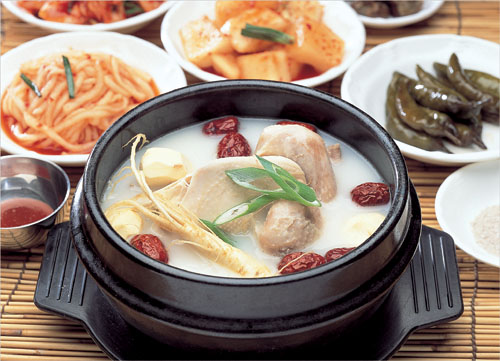
Samgyetang (Korean chicken soup) is a common Korean summer food. In order for Korean people to overcome the heat in the summer, they eat warm chicken soup. A dish in which ginseng is stuffed in a chicken, Samgyetang is not only tasty but also nourishing. During summer, people feel tired because of the heat, and so they believe that they need to eat good food. Therefore, there is a tradition of eating chicken soup on the hottest day of the summer. Eating of warm food on hot days comes from the saying, “fighting heat with heat”. In other words, because of the idea that a hot thing can be overcome by another hot thing, they eat chicken soup and they believe they can overcome summer heat. Therefore, while Korean people eat warm chicken soup, they say “Ah… so refreshing.” 

(Photo: Internet)


재외동포를 위한 한국어
[Let's learn Korean culture] Seeing a doctor is easy

[Let's learn Korean culture] Seeing a doctor is easy


병원에 가기 쉬워요
Seeing a doctor is easy
When Korean people get sick, they can see a doctor easily. Because there are many clinics in each district, it is possible to go in without making an appointment and having to wait for a long time. Because all Korean citizens have health insurance, they can visit a local clinic for non-major illnesses, and treatment bills are not expensive. For example, in the case of a common cold or upset stomach, it is alright to just go to a doctor at a local clinic and get the prescription filled at the drugstore. However, if it is a major illness, one may be transferred from a local clinic to a big hospital. To go to a big hospital, one first has to go to a local clinic and see the doctor. Nevertheless, people who get sick out of the blue can visit an emergency room at a big hospital. By calling 119, people who need to visit an emergency room can have an ambulance dispatched.

(Image: internet)
재외동포를 위한 한국어
[Let's learn Korean culture]  Family camping is popular in Korea

[Let's learn Korean culture] Family camping is popular in Korea

가족 캠핑이 유행이에요
Family camping is popular

Nowadays, family camping, where you take a trip with your family, is getting popular, specifically among people who live in cities. Many of them live in apartments, and so their kids do not have much of a chance to live in nature. Therefore, parents who live in apartments in cities go camping with their kids so that they can experience nature. To camp at a campsite, one needs a tent and amenities for cooking. As people who want to camp are increasing, many places that facilitate camping have developed. At the campsite, people cook and eat, and families can have a good time while playing ball games, water games, and the like.

(Photo: Internet)
재외동포를 위한 한국어
[Let's learn Korean culture] The rainy day

[Let's learn Korean culture] The rainy day

비 오는 날
The rainy day 
In Korea, there is a monsoon season. The monsoon season usually lasts from June to July, and the duration ranges from 2 to 3 weeks of continuous rain. There are days when it rains only a little, and there are also days that when it rains heavily in a short amount of time. Above all else, in the monsoon season, it feels even hotter because the weather is humid. When it rains, Korean people unfailingly use umbrellas. Especially if it rains suddenly and they don’t have umbrellas, Korean people will sometimes buy disposable umbrellas made of plastic. However, these umbrellas can be used for many times. These disposable umbrellas are good because they are not only inexpensive but also light and therefore convenient. 

(The photo source: internet)
재외동포를 위한 한국어
[Let's learn Korean culture] Korean street food

[Let's learn Korean culture] Korean street food

길거리 음식을 소개할게요
Let me introduce street food 
In Korea, one can see a lot of small stalls around the streets where there are lots of passersby or places that are crowded with people. These food stalls are not permanent structures, but they were made to be moveable. These stores sometimes sell food, small accessories or souvenirs. Common examples of street food are tteokpokki (spicy rice cake), eomuk (fish cake), kim-bab (seaweed rice roll) and sun-dae (Korean sausage). Most Korean people like these types of food, and they can be found quite easily. These streets are places where teenagers and young people can conveniently visit with their friends.


(Photo: Internet)
재외동포를 위한 한국어
[Let's learn Korean culture]  What are some good points of learning Chinese characters in order to learn Korean?

[Let's learn Korean culture] What are some good points of learning Chinese characters in order to learn Korean?

한국어에는 한자어가 많아요
Many Korean words written in Chinese characters
 Many Korean words are Chinese-based words, and the rest are genuine native words. Because of that, if one knows Chinese characters, it helps with the learning of Korean words. For example, if one learns the Chinese word 남(男), one knows that words containing this character mean something related to the word of “man.” In words like ‘남녀’ (man and woman), ‘남자’ (man), ‘남성’ (scientific word for “male”), ‘남동생’ (younger male brother), the element 남 has the meaning of “man.” However, in Korean words of Chinese origin, there are also characters that sound the same, but whose meanings are different. The Chinese character 남(南) has the meaning of “South”, instead of the meaning of “man.” Therefore, words with this “남(南)” element contain the meaning of “South,” as in ‘남극’ (South Pole), ‘남대문’ (South Gate), and ‘남동풍’ (South wind). Although one may not experience difficulty in learning Korean without knowing Chinese characters, if one knows Chinese characters, it is fun to infer the meaning of words that one sees for the first time by means of each Chinese character.

 (Photo source: Internet)
재외동포를 위한 한국어
[Let's learn Korean culture] Visit a traditional market in Korea

[Let's learn Korean culture] Visit a traditional market in Korea

전통 시장에 가 보세요
Visit a traditional market 

A place where many small stores are clustered together is called a traditional market. Nowadays because big supermarkets or discount stores pop up like mushrooms, a lot of traditional markets have died out. Nevertheless, depending on the neighborhood, there are still some areas that have small fresh markets, and there are also specialized markets that sell only produce or seafood. In Seoul, the fish market in Noryanjin, and the fresh produce and seafood market in Garak District are well known. If one goes to this (latter) place, one can see all kinds of fish, vegetables, and fruits. In particular, vendors sell their goods by calling out loudly to tell people to buy goods, thus attracting people’s attention. If one goes to a fresh market, one will experience an old and noisy atmosphere,
and it is fun to see new things. 

(Photo source: Internet)
재외동포를 위한 한국어
[Let's learn Korean culture] Don’t drink seaweed soup on an exam day

[Let's learn Korean culture] Don’t drink seaweed soup on an exam day

시험 보는 날 미역국은 안 돼요!
Don’t drink miyeokguk (seaweed soup) on an exam day 
Korean people eat miyeokguk on their birthdays. However, there are also days when eating miyeokguk is definitely not allowed. It is a forbidden food on an exam day, because the saying “I ate miyeokguk” is an expression that people use when someone failed an exam (as opposed to using it in the sense that someone really ate miyeokguk). Because seaweed is slippery, if one eats slippery food, this is associated with the likelihood of sliding out of the exam. Korean foods that are on the opposite end of the slippery seaweed are Chapssalddeok (rice cakes with sweet bean paste) or Yeot (sweet, sticky candy). Therefore, to students who take an exam, people give Chapssalddeok or Yeot due to their symbolism of “sticking.
(The photo: Internet)
재외동포를 위한 한국어
[Let's learn Korean culture] South Korean's national flower

[Let's learn Korean culture] South Korean's national flower

무궁화 꽃이 피었어요
Mugunghwa (Hibiscus) bloomed 
Mugunghwa is the flower of South Korea. Its height is approximately 2-4 meters, and the flowers bloom between July and October. There are about 200 species of Mugunghwa. There is a wide variety of colors, such as pink, white, violet, purple, etc. The flowers are beautiful, and because they are in bloom for a long time, people plant them in schools, government offices, parks, etc. Mugunghwa appears in the lyrics of the national anthem that we often sing too. Try singing it once. 


(Image: Internet)
재외동포를 위한 한국어
[Let's learn Korean culture] What is a volume-based disposal system in Korea?

[Let's learn Korean culture] What is a volume-based disposal system in Korea?

쓰레기는 쓰레기봉투에 버려요
Dispose of your garbage in a garbage bag 
In Korea, they use a volume-based disposal system. This volume-based system is a system where garbage collection fees are based on the amount of waste. Therefore, when disposing garbage at home, one has to put it in a garbage bag. While it is different in each local area, one can buy garbage bags at a supermarket. There are 10 liter, 20 liter, and 50 liter, etc bags. Garbage that can be recycled is disposed of in separate recycling bins. Food waste is put into a food disposal bag, or in a designated place. Disposing garbage is complicated, but it is something that necessarily has to be done for the environment.


재활용을 해요
Let’s recycle 
Recycling means not disposing of products that you already used but rather repurposing them, or making new products and reusing them. People melt cans or plastic and then make different products, and wastepaper can be made into paper products or toilet paper, etc., or it is sometimes re-used. If we recycle in this way, we can reduce waste and not only preserve our resources but also lessen environmental pollution. As a result, it is important that garbage that can be recycled is sorted into  similar types and then thrown away. These days, food waste, which used to be difficult to recycle, is made into compost or animal feed. In addition to that, people try to reduce garbage and prevent environmental pollution constantly

(Image: Internet)

이 쓰레기를 어디에 버릴까요? 
Where should I trash this garbage? 
At present, there are not many trash-cans on the streets of Korea. If it is possible, do not trash your garbage, because when you throw away your garbage, you must first consider whether it is recyclable before trashing it. Putting garbage only in designated places is called “garbage separation discharge.” Waste sorting is separating between recyclable things that can be used again, and general waste that has to be eliminated. Specifically, for recyclable items, we do not trash them all in the same place, but we sort them out depending on the type of item, such as paper, plastic, bottle, and so on. Therefore, while throwing away garbage is a difficult issue in Korea, these things that we do ourselves are a good way to protect nature.
 
재외동포를 위한 한국어
[Let's learn Korean culture] In the past, how did Korean people tell time?

[Let's learn Korean culture] In the past, how did Korean people tell time?

옛날에도 시계가 있었어요
There were also clocks in the past 
To tell time, the very first device people used was the sun dial. A sun dial is a system that measures time through the movement of the shadow in accordance with the movement of the sun. In Korea, during the Joseon period, in the year 1434 (16th year of the dynasty), the sun dial Angbuilgu was first created by Jang Yeong-sil and others. In this clock, 12 types of animals were engraved in the places that indicate time, each representing a 2-hour interval. Using this device, people could tell time and seasons. However, they could not tell time at night or when it was cloudy. As a result of this, in the year 1434 (16th year of Sejeong), Jang Yeongsil created a water clock, called “Jakyeokru”. The sounds of Jong (bell), Buk (drum) and Jing (gong) reveal the time even though it is night time or a cloudy day. To tell time using Jakyeokru, 12 types of animals come out in the designated order every two hours. With the invention of the sun dial and water clock, people during the Joseon period could organize daily routines at precise times and carry out their routines.

재외동포를 위한 한국어

 [Let's learn Korean culture] Koreans use honorific expressions for elders

[Let's learn Korean culture] Koreans use honorific expressions for elders

웃어른께 높임말을 써요
Koreans use honorific expressions for elders 
When you talk to older people in Korean, how do you speak?
In Korea, the culture that shows respect to older people developed a long time ago, and this kind of
culture shows up in the use of language, too. The use of honorifics symbolizes respect towards the
elderly. Let’s look at a few examples.
“Teacher, could you help me with this please?” (“선생님, 이것 좀 도와주세요.”)
“Grandpa, are you busy at the moment?” (“할아버지, 지금 바쁘세요?”)
“Grandma, have a good night.” (“할머니, 안녕히 주무세요.”)
If one uses honorifics correctly, this helps with your impressive rhetoric.
 
(Image source: Internet)
 재외동포를 위한 한국어
[Let's learn Korean culture] Let's yield seats to the elderly and the weak

[Let's learn Korean culture] Let's yield seats to the elderly and the weak

노약자에게 자리를 양보해요
Let's yield seats to the elderly and the weak 
On the bus or subway, there are seats for the elderly and the weak. These are seats for seniors, pregnant women, or disabled people. On these seats, it is either written “노약자석” or a notice sign is attached. When we take the bus or subway and see these seats, usually people do not like to sit there. Korean people usually think that when there are vacant seats in the regular seating area (which are not seats for the elderly and the weak), they should yield to the elderly and the weak too. Therefore, they look around if there is an elderly person or pregnant woman in the surroundings. Also, as they are sitting down, if an elderly or weak person gets on the bus, they stand up and give up the seat. In these gestures, we can feel a warm heart that shows respect to older people and people in need
(Image source: Internet)
 재외동포를 위한 한국어
[Let's learn Korean culture] Who are the characters on the Korean banknotes?

[Let's learn Korean culture] Who are the characters on the Korean banknotes?


지폐 속의 인물은 누구일까요?
Who are the characters on the banknotes? 
There are four types of Korean bank notes: 1,000 won, 5,000 won, 10,000 won, and 50,000 won. On the front side of these bills are drawings of characters, and on the back, are drawings of either landscapes or objects. On the front of the bills worth 1,000 and 5,000 won are well-known Joseon era scholars Yi Hwang and Yi Yulgok. On the 10,000 won bank note is King Sejong the great. King Sejong, the fourth king of the Joseon period, created Hangeul (Korean letters). On the bill worth 50,000 won is Shin Saimdang. Shin Saimdang is the mother of Yi Yulgok who appears on the 5,000 won bill. She was a great mother and an outstanding artist.


  재외동포를 위한 한국어
[Let's learn Korean culture] Let's make kimbap

[Let's learn Korean culture] Let's make kimbap

김밥을 만들어요
Let's make kimbap
When Korean people go on a picnic or are on a trip, the typical food that they prepare is kimbap. They sometimes make it at home, or they can have it at a kimbap restaurant. There are many types of kimbap, including grilled meat, tuna, cheese, and vegetable kimbap. As for the ingredients, they can change and be put in kimbap, depending on each person's preference.

<Cooking steps>

① Put salt and sesame oil in rice, and mix well.
② Prepare several kinds of ingredients.
③ First spread the rice evenly on top of the seaweed, and put the ingredients
over it.
④ Roll it perfectly.
⑤ Slice the kimbap nicely, and it’s ready to eat.

(Photo: Internet)
재외동포를 위한 한국어
[Let's learn Korean culture] Hiking - one of the recreational activities that Korean people like

[Let's learn Korean culture] Hiking - one of the recreational activities that Korean people like

등산을 좋아해요
I like hiking 
Hiking is one of the recreational activities that Korean people like. Because 70% of Korea’s land is made up of big and small mountains, it is easy to see mountains around. Mt. Seorak in Gangwon-do, Mt. Jiri in Jeolla-do and Gyeongsangnam-do, and Mt. Halla in Jenu-do are some of Korea’s famous mountains. At these places, regardless of the season---spring, summer, fall, or winter, there are a lot of hikers. In the spring, people go see flowers bloom, and in the summer, they take time-off at refreshing valley areas. In addition, in the fall, they go see autumn leaves, and in the winter, they go to see snowflakes. 
However, it does not have to be these high and famous mountains, there are also many small mountains in the vicinity of one's house. Therefore, on the weekend, we often see people who wear hiking gear on their way to hiking. Wearing hiking shoes, carrying a hiking backpack, and climbing up the mountain constitutes an important pastime of Korean people.

(Image: Internet)

재외동포를 위한 한국어
[Let's learn Korean culture] Talk through your body

[Let's learn Korean culture] Talk through your body

몸으로 말해요
Talk through your body 
We can also communicate through body language without speaking. While there is body language that is universal to all people around the world, each culture slightly differs from others. When Korean people say what action is prohibited, they usually either show the palm of the hand and wave, or make an X with their hands or with their fingers. When they want to express that the other party did well, they raise a thumb. Moreover, instead of saying “I love you”, they express it by raising two arms over the head, or using the thumb and index finger to make a heart figure


재외동포를 위한 한국어
[Let's learn Korean culture] Are taekkyeon and taekwondo the same?

[Let's learn Korean culture] Are taekkyeon and taekwondo the same?

택견과 태권도가 같아요?
Are taekkyeon and taekwondo the same?

Taekkyeon and taekwondo are both Korean martial arts. Both do not use weapons, but are practiced using bare hands. Taekkyeon was depicted on the walls of the ancient tombs of Goguryeo. Therefore, it is hypothesized that it started in the Three Kingdoms period. Taekkyeon attacks and defends by using smooth, circular movements of the body. Unlike the above, in taekwondo, there is a lot of movement with stances and the use of power. The name taekwondo has been used since 1955. In 2000, taekwondo was adopted as a sport at the Summer Olympics. At present, not only Korean people but also people in many countries all over the world learn taekwondo. 

 
(Photo: Internet)

재외동포를 위한 한국어