Showing posts with label Korea technology. Show all posts
김빛내리, 아시아 최초 HFSP 나카소네상 수상···RNA 연구로 mRNA 백신·치료제 개발 기여 - Kim V. Narry Wins Asia's First HFSP Nakasone Award for RNA Research Advancing mRNA Vaccines and Therapies

김빛내리, 아시아 최초 HFSP 나카소네상 수상···RNA 연구로 mRNA 백신·치료제 개발 기여 - Kim V. Narry Wins Asia's First HFSP Nakasone Award for RNA Research Advancing mRNA Vaccines and Therapies

 ▲ 기초과학연구원(IBS) 김빛내리 RNA 연구단장.Kim V. Narry, distinguished professor at Seoul National University and director of the Seoul-based Center for RNA Research at the Institute for Basic Science (IBS), is the first Asian to win the prestigious HFSP Nakasone Award. (IBS)[/caption]

한국인 연구자가 세계적 권위의 생명과학상인 '휴먼프론티어사이언스프로그램-HFSP 나카소네상'을 받는다. A domestic scholar has won the Human Frontier Science Program (HFSP) Nakasone Award, a prestigious international honor in the life sciences.

과학기술정보통신부는 기초과학연구원(IBS) 김빛내리 RNA 연구단장 겸 서울대 석좌교수가 2027년 HFSP 나카소네상 수상자로 선정됐다고 13일 밝혔다. 한국인과 아시아 연구자 가운데 이 상을 받은 것은 김 단장이 처음이다.

The Ministry of Science and ICT on July 13 said Kim V. Narry, distinguished professor at Seoul National University and director of the Seoul-based Center for RNA Research at the Institute for Basic Science, is the first Asian to win the prize.

김 단장은 RNA 말단에 꼬리를 붙여 안정성과 분해, 단백질 생성을 조절하는 ‘비전형적 RNA 꼬리 첨가 경로’를 발견했다. 유전자 발현이 조절되는 새로운 원리를 밝힌 이 연구는 지속성 높은 메신저리보핵산(mRNA) 치료제와 백신 개발의 분자적 기반을 제시했다는 평가를 받는다.

The HFSP on its site said she won "for her discovery of noncanonical RNA tailing pathways that established new regulatory layers of gene expression and laid the molecular foundation for durable mRNA therapeutics and vaccines."

HFSP는 생명과학 분야의 혁신적이고 도전적인 국제 공동연구를 지원하기 위해 1989년 설립된 프로그램이다. 지금까지 73개국 8500여 명의 연구자를 지원했다. 이 가운데 31명이 노벨상을 수상했다.

Launched in 1989, the Strasbourg, France-based program supports innovative and challenging global collaborative research in the life sciences. It has backed approximately 8,500 researchers from 73 countries, 31 of whom have gone on to win the Nobel Prize.

2010년 제정된 HFSP 나카소네상은 생명과학 분야에서 과학적 진보나 한계 돌파를 이뤄낸 연구자에게 수여된다. 역대 수상자 21명 가운데 4명이 노벨상을 수상해 '노벨상으로 가는 징검다리'로도 불린다.

The Nakasone Award, established in 2010, recognizes researchers who have achieved scientific progress or broken new ground in the life sciences. Four of the past 21 winners have gone on to receive the Nobel Prize.

김 단장은 내년 HFSP 연례학술대회에서 기념 강연을 하고 기념 메달과 상장, 연구지원금 1만 5000 달러를 받는다.

Kim will deliver a commemorative lecture at the HFSP Awardees Meeting next year and receive a medal, certificate and research grant of USD 15,000.

강가희 기자 kgh89@korea.kr
By Kang Gahui, kgh89@korea.kr

포스텍, 초박형 반도체 칩 적층 기술 개발… AI 메모리 성능 향상 기대 🇺🇸 POSTECH Develops Ultra-Thin Semiconductor Chip Stacking Technology for Faster AI Memory

포스텍, 초박형 반도체 칩 적층 기술 개발… AI 메모리 성능 향상 기대 🇺🇸 POSTECH Develops Ultra-Thin Semiconductor Chip Stacking Technology for Faster AI Memory

 ▲ 전사 프린팅 및 실시간 본딩 모식도. a) 공정 모식도. b) 초고밀도 집적 모식도. c) 전사 프린팅 및 실시간 본딩 기반 집적 공정 전개도. These illustrations demonstrate the stable stacking method of uber-thin semiconductor chips developed by a joint research team of Pohang University of Science and Technology (POSTECH) and the Korea Institute of Industrial Technology. (POSTECH - 포항공과대학교)

한국 연구팀이 머리카락 굵기 5분의 1에 불과한 초박형 반도체 칩을 10층 이상 안정적으로 쌓아 올리는 기술을 개발했다. 고대역폭 메모리(HBM)보다 집적 밀도를 4배나 높인 획기적인 성과다.

A joint research team has developed a stable stacking method of over 10 layers of ultra-thin semiconductor chips, each a fifth the thickness of a human hair, that raises integration density to four times that of high-bandwidth memory (HBM).

포항공과대학교(포스텍)과 한국생산기술연구원 공동 연구팀은 칩을 옮기는 동시에 금속 접합까지 가능한 새로운 공정을 개발, 기존 고성능 메모리보다 약 4배 높은 집적 밀도를 구현하는 데 성공했다고 지난달 30일 밝혔다.

Researchers from Pohang University of Science and Technology (POSTECH) and the Korea Institute of Industrial Technology on June 30 said they developed a process of transferring semiconductor chips and simultaneously creating metallic interconnections, resulting in integration density 400% higher than conventional high-performance memory.

스마트폰은 갈수록 얇아지는 반면 반도체는 더 강력해져야 하는 상황에서, 반도체 업계는 칩을 옆으로 넓히는 대신 위로 높이 쌓는 구조에 집중하고 있다. 특히 AI 반도체의 성능을 좌우하는 HBM는 메모리 칩을 여러 개 층층이 쌓아 만드는 구조여서 얼마나 많은 칩을 안정적으로 쌓을 수 있는지가 핵심 경쟁력으로 꼽힌다.

As smartphones get thinner, semiconductors need to process enormous amounts of data at extremely high speeds. Thus the semiconductor sector is focusing on vertically instead of horizontally stacking chips.

HBM, which determines the performance of artificial intelligence semiconductors, is built by stacking multiple memory chips layer on layer, thus the technology to stack a high number of chips is considered a key competitive advantage.

문제는 칩이 얇아질수록 휘거나 깨지기 쉬워 다루기가 까다롭다는 점이다.

The problem is that a thinner chip is more susceptible to bending, warping and fracture, making it difficult to handle during manufacturing.

이에 연구팀은 칩을 원하는 위치에 정밀하게 옮겨 붙이는 '전사 프린팅' 기술과 칩을 이송하는 순간 금속을 접합하는 '실시간 본딩' 기술을 결합했다. 칩을 옮기고, 붙이고, 연결하는 세 가지 과정을 단 한 번의 공정으로 단축한 것이다.

To overcome this limitation, the team combined two technologies into a single process platform: transfer printing to precisely place chips in their intended positions and In-situ bonding to form metallic bonds simultaneously during chip transfer. This integrates chip transfer, placement and electrical interconnection into a single manufacturing step.

연구팀은 이 공정을 활용해 두께 약 14마이크로미터의 초박형 실리콘 칩을 180도 이하의 저온, 20킬로파스칼 이하의 저압 조건에서 칩을 10층 이상 안정적으로 쌓아 올리는데 성공했다. 쌓은 뒤에도 층간 정렬 오차가 작았고, 휨 현상도 최소화됐다는게 포스텍 설명이다. 같은 높이 안에 더 많은 칩을 담을 수 있는 길을 열게 된 셈이다.

Using the process, the team stably stacked over 10 ultra-thin silicon chips, each about 14 micrometers thick, at low temperatures below 180 degrees Celsius and low pressure below 20 kilopascals.

POSTECH said the stacked chips maintained high alignment accuracy with minimal warping, allowing the stacking of more chips within the same package height.

포스텍은 "이번 기술은 AI 반도체뿐 아니라 여러 기능의 칩을 하나의 패키지에 묶는 칩렛 기술, 초소형 발광소자를 활용한 마이크로 발광다이오드(LED) 디스플레이 분야에도 적용할 수 있다"며 "고성능 AI 반도체와 차세대 메모리 시스템 개발의 핵심 기반 기술로 활용될 것으로 기대한다"고 말했다.

"This technology is applicable not only to AI semiconductors but also chiplet-based technology, which integrates multiple functional chips into a single package, and micro-LED displays," POSTECH said. "This is expected to emerge as a core foundational technology for developing high-performance AI semiconductors and next-generation memory systems."

이번 연구 결과는 다학제 공학 분야 국제 학술지 '리절츠 인 엔지니어링(Results in Engineering)' 온라인판에 게재됐다.

The study was published in the online edition of the international academic journal Results in Engineering.

샤를 오두앙 기자 caudouin@korea.kr
By Charles Audouin, caudouin@korea.kr

피지컬 AI 시대 개막… 마음AI 진도봇, 산업·농업·국방 현장 혁신 이끈다 - Physical AI Enters the Real World: Maum AI's JINDO BOT and Woochi Bot Transform Industry

피지컬 AI 시대 개막… 마음AI 진도봇, 산업·농업·국방 현장 혁신 이끈다 - Physical AI Enters the Real World: Maum AI's JINDO BOT and Woochi Bot Transform Industry

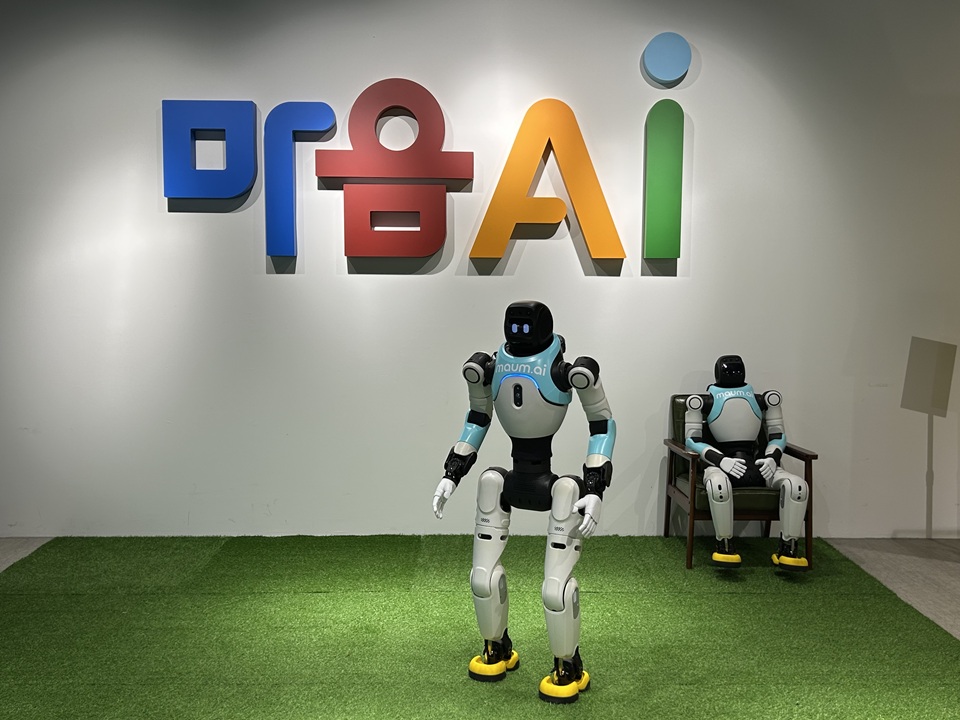
▲ 행사와 전시 현장의 운영을 지원하는 퍼포먼스형 휴머노이드 로봇 '우치봇(Woochi Bot)'. The photo on May 21 shows Woochi Bot, a performance-style humanoid robot that assists the operations of an event or exhibition, developed by a domestic physical artificial intelligence (AI) company, Maum AI, at the headquarters of the firm in Seongnam City, Gyeonggi-do Province.

인공지능(AI)이 디지털 공간을 넘어 실제 세계에서 판단하고 움직이는 '피지컬 AI' 시대로 진입했다. The era of physical artificial intelligence (AI) is one in which AI decides and acts beyond the digital space.

센서로 주변 환경을 인식하고 로봇의 옷을 입고 이동하며, 현장에서 스스로 판단하고 실행하는 것. 바로 '피지컬 AI'다. 기존 AI가 텍스트, 이미지, 음성 등 디지털 데이터를 중심이었다면, 피지컬 AI는 제조, 물류, 보안, 국방, 재난 대응 등 현실 공간을 무대로 삼는다. AI의 경쟁 기준도 "얼마나 많이 알고 있는가"에서 "현실 세계에서 무엇을 안전하게 실행할 수 있는가"로 바뀌고 있다.

Physical AI perceives its surrounding environment through sensors, moves in a robotic outfit, makes decisions and executes actions on its own at a site. While conventional AI focuses on digital data such as text, images and speech, physical AI operates in the real world in sectors like manufacturing, logistics, security, defense and disaster response.

AI competitiveness criteria are also shifting from depth of knowledge to what it can safely perform in the real world.

 ▲ 캔을 박스에 넣고 빼는 작업을 학습하고 있는 로봇. The photo shows a humanoid robot that learns to insert and remove cans from a box at Maum AI's headquarters in Seongnam City, Gyeonggi-do Province.

글로벌 기술 패권 경쟁 속에서 정부의 움직임도 빨라졌다. 과학기술정보통신부는 지난달 21일 프레스투어를 마련해 한국의 피지컬 AI 발전 현황을 설명하며 4족 보행 로봇 플랫폼 '진도봇' 기술 개발 현장을 공개했다.

이날 정부가 주목한 기술 현장의 중심에 한국 새싹 기업(스타트업) '마음AI'가 있다. 마음AI는 AI 파운데이션 모델, 엣지 디바이스, 자율 로봇, 통합 관제 솔루션을 하나로 연결한 피지컬 AI 체계를 구축했다. 특히 산업용 로봇이 현장에서 생성하는 데이터를 체계적으로 수집, 분석, 학습하는 한국 제1호 피지컬 AI 데이터팩토리를 선보여 주목받고 있다.

Korea is accelerating its efforts to take the lead in the competition for global technological dominance. The Ministry of Science and ICT on May 21 hosted a media tour at Maum AI, a physical AI startup, in Seongnam, Gyeonggi-do Province, outlining its homegrown development of physical AI and unveiling the development site for the quadruped robot platform Jindo Bot.

Maum AI is at the center of technology drawing strong government attention. Its physical AI structure integrates AI foundation models, edge devices, autonomous robots and unified control solutions.

The company launched the country's first physical AI data factory that systematically collects, analyzes and learns from data produced by industrial robots on site.

이곳에서는 로봇의 카메라가 촬영한 영상 데이터와 실제 움직임 데이터를 한 쌍으로 묶어 AI 모델을 훈련시킨다. 가상 시뮬레이션, 로봇 실증 환경, 상용 현장으로 이어지는 3단계 학습 순환 구조를 기반으로 작동한다.

유태준 마음AI 대표는 "사람이 처음에는 물건을 잘 잡지 못하지만 반복 학습을 거치면서 자연스럽게 잡는 과정과 같다"라고 설명했다.

At this site, AI models are trained using paired datasets of video data through a robot's camera and movement data. Operations are based on a three-stage learning cycle comprising virtual simulations, a real-world robot testing environment and commercial operational sites.

Maum AI CEO Yoo Taejoon said, "This is similar to the process through which a person initially struggles to grab objects but learns to do so naturally through repeated practice."

피지컬 AI는 이미 산업 현장 깊숙이 침투했다. 농업 분야에서는 과수원에서 나무 사이를 피해 이동하며 농약을 살포하는 자율주행 기계가 이미 상용화 단계에 이르렀다. 축사 환경에서 스스로 오물을 치우는 장비 개발도 한창이다.

Physical AI has deeply penetrated industrial settings. In agriculture, self-moving machines that can navigate between trees in orchards while spraying pesticide have entered the commercial application stage. Equipment that autonomously clears waste at livestock facilities are also under development.

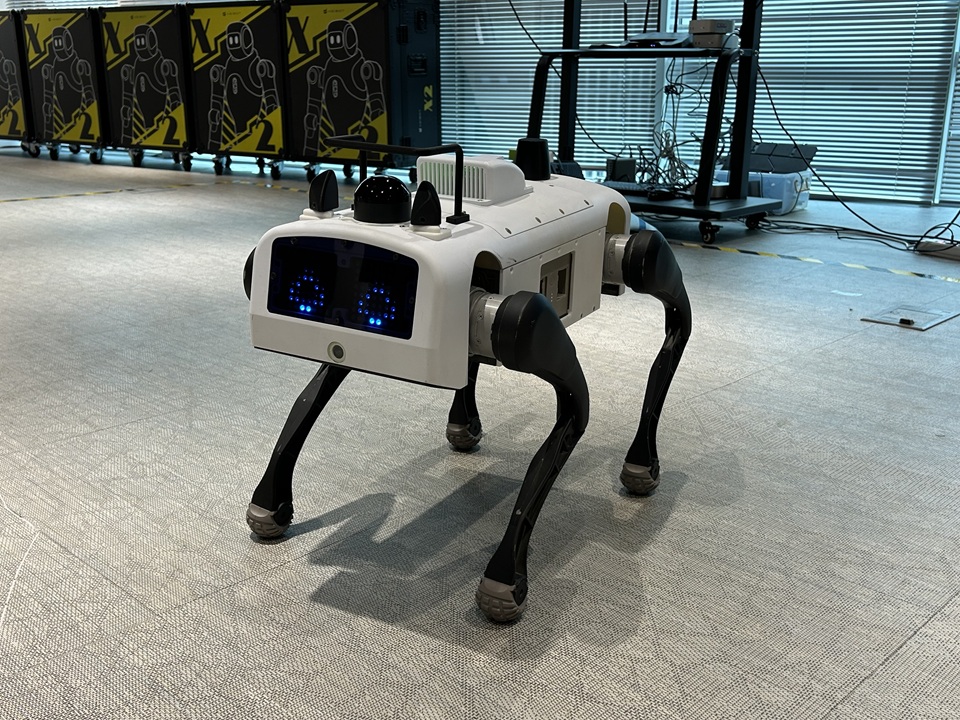
▲ 시각과 언어, 행동을 인식하고 사람의 지시를 이해해 자율적으로 움직이는 국내 생산 4족 보행 로봇 '진도봇(JINDO BOT)'. The photo on May 21 shows Jindo Bot, a domestically developed quadruped robot that recognizes vision, language and behavior, understands human instructions and moves autonomously, at the headquarters of Maum AI in Seongnam City, Gyeonggi-do Province.

대표적인 제품인 4족 보행 로봇 진도봇(JINDO BOT)은 사람이 직접 조종하지 않아도 주변 환경을 인식해 스스로 경로를 찾아간다. 실내외 시설 순찰, 침입 감지, 화재 탐지, 야간 감시 등 산업 현장에서 요구되는 임무를 수행하도록 설계됐다.

The company's flagship product, the quadruped robot Jindo Bot, perceives its surroundings and navigates autonomously without direct human control. The gizmo can perform tasks required at industrial settings such as patrolling indoor and outdoor facilities, detecting intrusion, identifying fires and conducting nighttime surveillance.

마음AI는 진도봇 시리즈를 보안, 물류, 설비 점검뿐 아니라 군사 시설 순찰과 위험 지역 정찰 등 국방과 재난 대응 분야로 확장할 계획이다.

Its Woochi Bot, a performance-oriented humanoid robot, also demonstrates human-interaction capabilities by learning dance and movement.

Maum AI plans to expand the application of the Jindo Bot series beyond security, logistics and equipment inspection to defense and disaster response such as patrolling military facilities and scouting hazardous areas.

여기에 퍼포먼스형 휴머노이드 로봇 우치봇(Woochi Bot)에 춤과 동작을 학습시키며 사람과 상호작용 능력도 증명해 나가고 있다.

Its Woochi Bot, a performance-oriented humanoid robot, also demonstrates human-interaction capabilities by learning dance and movement.

유 대표는 "노약자와 아이 돌봄 운영 지원이 가능한 휴머노이드 로봇까지 종류를 확대하기로 하고 준비 에 박차를 가하고 있다"라고 말했다.

Yoo said, "We've decided to expand our lineup to include humanoid robots that assist with caring for the elderly and children and are accelerating preparation."

성남 = 글·사진 테레시아 마가렛 기자 margareth@korea.kr
By Margareth Theresia, margareth@korea.kr

KAIST, 상온 원유 분리막 기술 개발… 끓이지 않는 차세대 정유 공정 구현 - KAIST Develops Room-Temperature Crude Oil Membrane Technology for Energy-Efficient Refining

KAIST, 상온 원유 분리막 기술 개발… 끓이지 않는 차세대 정유 공정 구현 - KAIST Develops Room-Temperature Crude Oil Membrane Technology for Energy-Efficient Refining

 ▲ 상온에서 가압한 원유를 다공성 분리막에 흘려보내 휘발유·나프타·등유 등 가벼운 성분만 걸러내는 공정 모식도. This schematic diagram shows the process in which pressurized crude oil at room temperature is passed through a porous separation membrane to filter out light components only such as gasoline, naphtha and kerosene. (KAIST professor Koh Dong-Yeun - KAIST 고동연 교수)

국내 연구진이 원유를 고온으로 끓이지 않고 상온에서 분리할 수 있는 고분자 분리막 기술을 개발했다. A research team at the country's top science and technology university has developed a polymer membrane technology that separates crude oil at room temperature without heating it to higher temperatures.

과학기술정보통신부가 이 같은 카이스트(KAIST) 고동연 교수 연구진의 연구 결과가 국제학술지 네이처(Nature)에 24일(현지 시간) 게재됐다고 25일 밝혔다.

The Ministry of Science and ICT on June 25 said the findings of the team led by Koh Dong-Yeun, a professor at the School of Chemical and Biomolecular Engineering of the Korea Advanced Institute of Science and Technology (KAIST), were published the day before in the international journal *Nature*.

현재 정유 공정은 원유를 350도 이상으로 가열한 뒤, 끓는점 차이를 이용해 휘발유·등유·경유 등으로 나누는 증류 방식에 의존한다.

Oil refining processes have traditionally relied on distillation, in which crude oil is heated to 350 degrees Celsius or higher and then separated into products such as gasoline, kerosene and diesel based on varying boiling points.

이번 연구에서 연구진은 다공성 고분자 분리막을 이용해 원유 성분을 분리하는 기술을 개발했다.

The KAIST study devised a technology using a porous polymer membrane to separate crude oil components.

실험 결과 새 분리막은 기존 기술보다 분리 속도가 23배 이상 빨랐고, 28일 동안 안정적인 성능을 유지했다.

Experiments found that the new separation membrane was over 23 times faster than conventional technologies while maintaining stable performance for 28 days.

연구진은 이 기술을 활용하면 에너지 사용량은 31.6%, 이산화탄소 배출량은 37.6%, 운영비는 36% 줄일 수 있을 것으로 분석했다.

The team said use of this technology could reduce energy consumption 31.6%, carbon dioxide emissions 37.6% and operating costs 36%.

고 교수는 "이번 연구는 원유가 분리막을 통과하면서 스스로 최적의 분리 통로를 만든다는 새로운 원리를 규명한 성과"라고 설명했다.

Koh said, "This study has identified a new principle in which crude oil creates its own optimal separation pathway while passing through a separation membrane."

고현정 기자, hjkoh@korea.kr
By Koh Hyunjeong, hjkoh@korea.kr

한국 연구진, 우주쓰레기 태워 없애는 궤도이탈장치 개발 성공 - New Korean De-Orbit Device Uses Drag Sail to Burn Up Dangerous Space Junk

한국 연구진, 우주쓰레기 태워 없애는 궤도이탈장치 개발 성공 - New Korean De-Orbit Device Uses Drag Sail to Burn Up Dangerous Space Junk

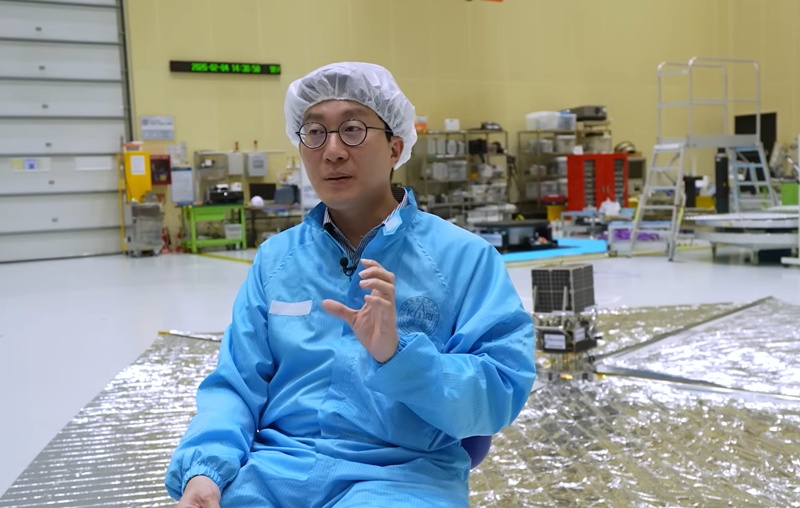
▲ 김민기 한국항공우주연구원 우주탐사팀 책임연구원이 우주쓰레기를 포획·제거할 수 있는 궤도이탈장치를 설명하고 있다. Kim Min-ki, principal researcher of the Space Exploration Team at the Korea Aerospace Research Institute (KARI), explains an orbital deorbiting device capable of capturing and removing space debris. (KARI - 항공우주연구원)

지구 궤도를 떠도는 우주쓰레기가 새로운 위협으로 떠올랐다. 수명을 다한 위성과 로켓 잔해들이 초속 8㎞ 이상의 속도로 이동하며 우주선과 우주인의 안전까지 위협하고 있어서다. 영화 속에서나 보던 우주 파편 충돌 장면이 현실 문제로 다가 온 셈이다.
 
Debris orbiting Earth is a new threat created by the space industry. Defunct satellites and rocket debris travel at speeds over 8 km per second, jeopardizing the safety of spacecraft and astronauts.
 
Thus collisions with space debris, once only seen in movies, have emerged as a real-world problem.
 
우주항공청이 지난해 확인한 우주쓰레기는 2만여 개에 달한다. 일부는 지구로 추락하기도 하지만, 대부분은 궤도에 남아 다른 우주물체와 충돌 위험을 높인다. 문제는 제거에 막대한 비용이 든다는 점이다.
 
The Korea AeroSpace Administration last year identified about 20,000 pieces of space debris, with some re-entering Earth's atmosphere but most remaining in orbit to raise the danger of collision with other space objects. The problem is the incredibly high cost of removing such debris.
 
이 같은 난제를 해결하기 위해 한국항공우주연구원(항우연)이 해결사로 나섰다. 항우연이 지구 저궤도에서 급증하는 우주쓰레기를 포획·제거할 수 있는 궤도이탈장치를 개발하고, 지상 시연에 성공했다고 최근 밝혔다. 핵심은 '분리형 시스템'이다. 우주쓰레기 제거 위성과 실제 궤도 이탈을 수행하는 장치를 이원화한 구조다.
 
Korea Aerospace Research Institute (KARI) is working to resolve this problem. The think tank recently announced its development of an orbital deorbiting device capable of capturing and removing the rapidly surging amount of space debris in low Earth orbit and a successful ground demonstration. The key lies in a "separable" system that divides the satellite used to remove space debris from the device that deorbits.
 
기존 우주 파편 제거 방식은 청소 위성이 우주쓰레기를 포획한 뒤 대기권에 동반 진입해 소멸하는 형태였다. 고가의 위성을 일회성으로 소모해 경제성이 극히 낮다는 치명적인 약점을 지닌다.
 
Conventional methods for removing such debris saw cleanup satellites capture the trash and re-enter the atmosphere with it, which would incinerate the debris. The critical flaw of this approach was its use of expensive satellites as disposable assets, making it extremely uneconomical.
 
항우연은 하나의 청소위성에 소형 궤도이탈장치를 여러 개 탑재해 이 문제를 정면 돌파했다. 청소 위성은 궤도에 남아 반복 사용하고, 개별 장치는 각각의 우주쓰레기에 달라붙어 제거를 전담하는 구조다. 재사용과 경제성을 획기적으로 높일 수 있다게 항우연 설명이다.
 
KARI tackled this problem head-on by loading multiple small orbital departure devices on one single cleanup satellite. The satellite remains in the orbit for multiple uses, while the devices attach themselves to specific debris for the latter's removal.
 
The institute said this approach can drastically improve reusability and cost-effectiveness of cleanup operations.
 
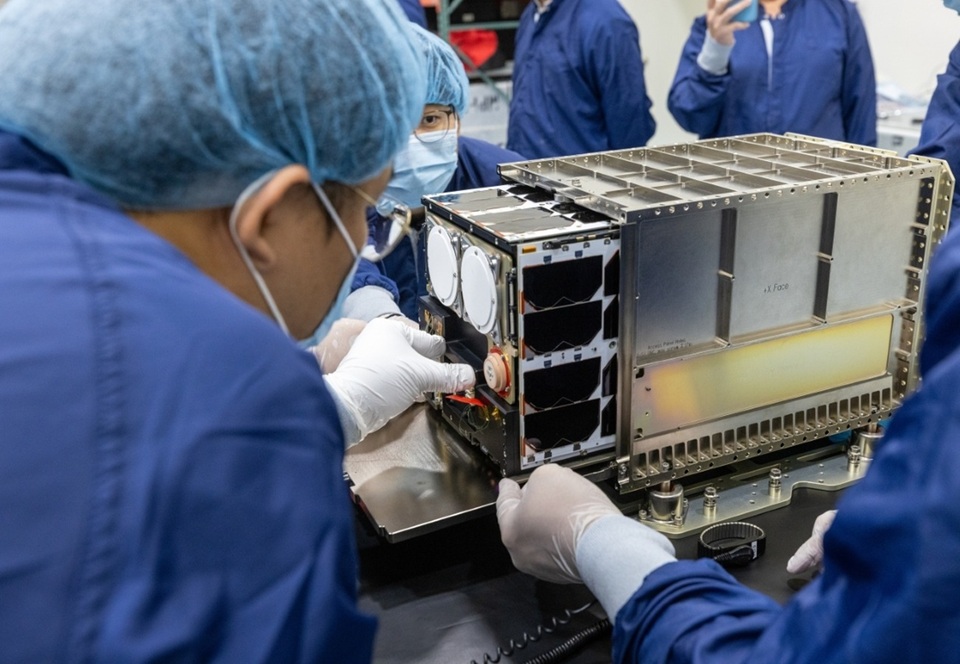
 ▲ 한국항공우주연구원 위성시험동 발사환경시험실에서 시험중인 궤도이탈 장치의 전체 형상. This is the orbital escape device being tested at the Satellite Test Building of Korea Aerospace Research Institute in Daejeon. (KARI - 항공우주연구원)
 
이번에 개발된 궤도이탈장치는 전기밥솥 크기의 소형 장치다. 작동 원리는 정교하다. 먼저 접착식 견인판을 우주쓰레기에 부착해 장치 쪽으로 끌어당긴다. 이후 네 개의 집게(그리퍼)가 우주쓰레기를 단단히 고정하면 저항돛(Drag Sail)이 사방으로 펼쳐진다. 장치 본체는 작지만, 저항돛을 펼쳤을 때 약 25㎡ 까지 커진다.
 
The new orbital deviation device is a compact unit the size of an electric rice cooker and with a sophisticated operating principle.
 
First, an adhesive towing plate is attached to space debris to pull it toward the device. Four grippers firmly secure the debris in place, after which a drag sail spreads in all directions.
 
The main unit is small but expands to about 25 square meters when the sail is deployed.
 
이 저항돛은 추진기나 별도 전력 없이 탄성에너지만으로 전개된다. 돛이 펼쳐지면 저궤도의 미세한 대기 입자와 마찰로 저항이 발생한다. 이 마찰력으로 우주쓰레기의 속도가 줄어들면서 궤도가 점차 낮아진다. 결국 대기권으로 재진입해 불타 소멸하는 ‘궤도이탈(De-orbiting)’ 작동 방식이다.
 
The sail spreads using only elastic energy and with no need for a propeller or separate power source. Once deployed, the sail generates drag through friction with fine atmospheric particles in low Earth orbit, and this frictional force slows the debris, gradually lowering its orbit.
 
In the end, this "de-orbiting" mechanism causes the debris to re-enter the atmosphere and burn up.
 
연구진은 실제 우주 적용에 앞서, 견인·포획·저항돛 전개 등 세 가지 핵심 기능 시연에 성공했다. 특히 전기 구동장치 사용을 최소화해 무동력 방식으로도 우주쓰레기 제거가 가능하다는 점을 입증했다.
 
Before application in space, the research team tested the device's three main functions: towing, capture and deployment of the drag sail. Members confirmed removal of the debris under a non-powered method by minimizing the use of electric actuators.
 
이 기술은 우주쓰레기 제거뿐 아니라 랑데부·도킹 기술, 심우주 태양돛 추진 기술 등 다양한 우주 분야에도 활용될 전망이다.
 
Application of this technology is expected in other space-related uses like rendezvous and docking and deep-space solar sail propulsion as well as removal of space debris.
 
김민기 한국항공우주연구원 책임연구원은 “지구 주변의 우주쓰레기가 계속해서 증가하는 상황” 이라며 “이번 연구는 재사용성과 경제성을 모두 갖춘 새로운 우주쓰레기 제거 기술의 가능성을 검증한 쾌거”라고 의미를 부여했다.
 
"Space debris around Earth continues to increase," said Kim Min-ki, a principal researcher at KARI. "This research marks a major achievement in confirming the potential of a new technology for space debris removal offering both reusability and cost-effectiveness."
 
고현정 기자 hjkoh@korea.kr
By Koh Hyunjeong
한국 큐브위성, 아르테미스 2호와 우주로···유인 달 탐사 첫 참여 - Cube satellite to gauge space radiation for Artemis II mission

한국 큐브위성, 아르테미스 2호와 우주로···유인 달 탐사 첫 참여 - Cube satellite to gauge space radiation for Artemis II mission

 ▲ 큐브위성 K-라드큐브가 실린 미국항공우주국(NASA)의 유인 달 탐사 프로젝트 아르테미스 2호가 1일 오후 6시 35분(현지 시간) 미국 플로리다주 케네디우주센터에서 발사되고 있다. NASA's Space Launch System rocket for the manned lunar mission Artemis II, carrying Korea's K-RadCube, was launched on April 1 at 6:35 p.m. from the Kennedy Space Center in Florida.

한국이 개발한 큐브위성 'K-라드큐브'가 1일 오후 6시 35분(현지 시간) 미국 플로리다주 케네디우주센터에서 발사된 '아르테미스 2호'에 실려 우주로 향했다.

K-RadCube, a domestically developed cube satellite, was launched aboard the Artemis II mission on April 1 at 6:35 p.m. from the Kennedy Space Center in Florida.

우주항공청은 이날 오후 11시 58분 K-라드큐브가 고도 약 4만km에서 성공적으로 분리돼 지구 고궤도에 진입했다고 밝혔다.

The Korea AeroSpace Administration said that at 11:58 p.m. that day, K-RadCube successfully separated at an altitude of about 40,000 km and entered a high Earth orbit.

K-라드큐브는 지구 고타원궤도(High Earth Orbit)에서 우주 방사선 특성을 관측한다. 향후 유인 달 탐사와 심우주 탐사에 필수적인 방사선 위험 평가 기초 자료를 확보할 방침이다. 한국이 참여하는 아르테미스 프로젝트의 첫 유인 탐사 관련 실전 임무다.

K-RadCube observes space radiation from a highly elliptical orbit to gather key data for radiation risk assessment, which is essential for future manned lunar and deep space exploration.

This marks Korea’s first practical mission related to a manned Artemis project.

K-라드큐브는 고도 약 200 km에서 약 7만km에 이르는 광범위한 범위의 궤도를 비행하며 반앨런대(Van Allen belts) 안팎을 오가면서 다양한 방사선 환경에서 고에너지 입자의 분포와 특성을 관측한다.

The satellite flies in a wide orbit ranging from about 200 km to 70,000 km, moving in and out of the Van Allen belts to observe the distribution and characteristics of high-energy particles in various radiation environments.

위성에는 삼성전자와 SK하이닉스의 반도체가 탑재돼 극한 우주 환경에서 방사선에 노출된 반도체의 내구성을 실증하는 임무도 수행한다.

Equipped with semiconductors from Samsung Electronics and SK Hynix, the satellite will also test the durability of chips exposed to radiation in extreme space environments.

우주항공청은 K-라드큐브의 임무운영센터에서 위성으로부터 데이터를 확보하기 위해 스페인 마스팔로마스(Maspalomas) 지상국을 통해 교신을 시도하고 있다고 밝혔다. 칠레 푼타 아레나스(Punta Arenas), 미국 하와이, 싱가폴 등의 지상국과도 연계해 위성 신호를 추적한다.

KASA said it is attempting communication via the Maspalomas ground station in Spain to obtain data from the satellite.

It is also tracking signals through coordination with stations in Punta Arenas (Chile), Hawaii (U.S.) and Singapore.

▲ K-라드큐브는 신발 상자 크기의 12유닛(가로·세로·높이 각 10cm) 큐브위성이다. 무게는 19.6kg이다. The K-RadCube is a 12-unit cube satellite roughly the size of a shoebox (10 cm per side) and weighs 19.6 kg.

샤를 오두앙 기자 caudouin@korea.kr
사진 = 미국항공우주국(NASA)
By Charles Audouin, caudouin@korea.kr
Photos = NASA

치명률 75% '니파바이러스' 선제 대응···치료제·백신 개발 '속도전' - Think tank pledges accelerated efforts vs. deadly Nipah virus

치명률 75% '니파바이러스' 선제 대응···치료제·백신 개발 '속도전' - Think tank pledges accelerated efforts vs. deadly Nipah virus

 ▲니파바이러스는 감염 시 급성 뇌염 등을 유발하며 높은 치명률을 보이지만 현재 전 세계적으로 상용화된 백신이나 치료제가 없다. The deadly Nipah virus can cause acute encephalitis upon infection and has a high fatality rate, with no commercialized vaccines or treatments. (iClickArt) Unauthorized reproduction and redistribution of this image is prohibited under copyright law.

정부가 치명률이 75%에 달하는 고위험 인수공통감염병 '니파바이러스'에 맞서 치료제와 백신 개발에 속도를 내고 있다.

The National Institute of Health (NIH) is speeding up development of treatments and vaccines against the deadly Nipah virus, a high-risk zoonotic disease with a fatality rate as high as 75%.

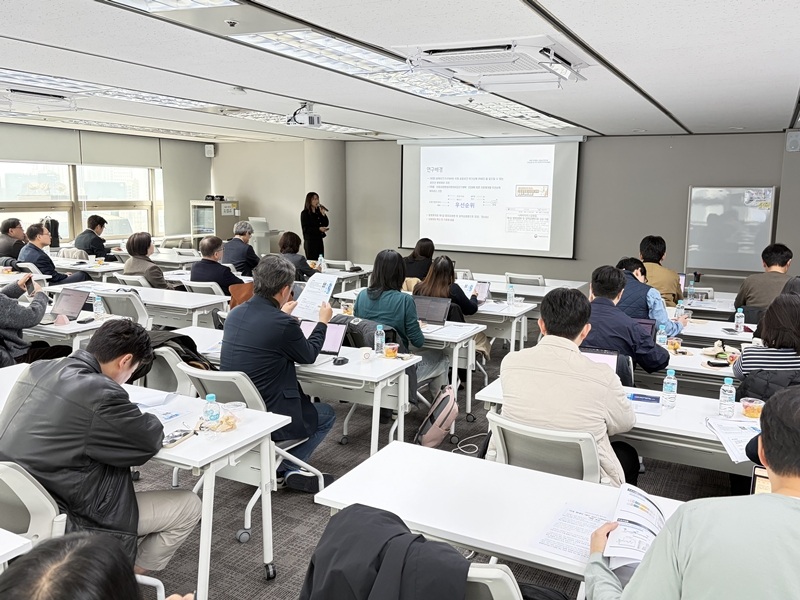
국립보건연구원은 17일 서울 종로구 HJ비즈니스센터 광화문에서 열린 '2026년 제1회 과학미디어아카데미'에서 니파를 비롯한 코로나19, 메르스 등 8종의 치료제 개발을 최우선 과제로 선정하고, 오는 2030년까지 관련 기술을 완비해 국가 방역 체계의 대응력을 높이겠다고 밝혔다.

At the inaugural Science Media Academy on March 17 at HJ Business Center in Seoul, the NIH announced that developing treatments for eight diseases including Nipah, COVID-19 and MERS is its top priority.

The goal is to complete related technologies by 2030 to strengthen the national disease response system.

연구원은 현재 물질 발굴 단계인 치료제 개발에 연구 역량을 결집해 오는 2028년 비임상 평가를 거쳐 2030년 이후 생산 공정 고도화를 이룰 계획이다.

The focus is on therapeutic development currently in the discovery phase.

Nonclinical evaluations are planned for 2028, followed by advancement of production processes after 2030.

백신 분야 또한 mRNA 등 신기술을 접목해 오는 2029년엔 임상시험을 하겠다는 구상이다. 이는 단순한 약물 개발을 넘어 향후 감염병 발생 즉시 대응이 가능한 백신 개발 체계를 구축하겠다는 포석이다.

The NIH plans to incorporate new technologies such as mRNA to begin clinical trials by 2029.

This aims to build a system capable of rapid vaccine response to future infectious disease outbreaks.

▲ 국립보건연구원이 17일 서울 종로구 HJ비즈니스센터 광화문에서 열린 '2026년 제1회 과학미디어아카데미'에서 니파바이러스 국내 치료제 및 백신 개발 전략을 발표하고 있다. The National Institute of Health presents its strategy to develop treatments and vaccines for the Nipah virus at the Science Media Academy held in Seoul. (NIH - 국립보건연구원)

치명률이 40~75%에 이르는 니파바이러스는 지난 1998년 말레이시아에서 처음 보고된 이후 인도와 방글라데시 등지에서 지속적으로 발생하고 있다. 지난 1월에도 감염 사례가 확인되면서 한국 유입 우려가 커지고 있다. 그러나 지금까지 상용화된 치료제나 백신은 전혀 없는 실정이다.

Since first reported in Malaysia in 1998, Nipah virus has continued to occur in countries such as India and Bangladesh with a fatality rate of 40%–75%.

Concerns over its entry into Korea are rising after cases were confirmed in January, and there are still no commercialized treatments or vaccines.

니파바이러스 감염증은 코로나19와 같은 호흡기 감염병이 아니다. 생 대추야자 수액 등 오염된 식품 섭취나 과일박쥐·돼지 등 감염 동물과의 접촉, 환자의 체액과의 밀접 접촉 등을 통해 전파된다. 감염 시 초기 증상은 발열과 두통 등 감기와 유사한 증상을 보인다. 중증으로 진행되면 급성 뇌염 등 신경학적 증상이 나타나 사망에 이를 수 있다.

Unlike COVID-19, Nipah is not a respiratory disease. It spreads through contaminated food such as raw date sap, contact with infected animals like fruit bats and pigs, or close contact with bodily fluids of infected individuals.

Early symptoms resemble the common cold, such as fever and headache, but severe cases can lead to neurological symptoms like acute encephalitis and death.

위험성이 큰 만큼 질병관리청은 지난해 9월 니파바이러스 감염증을 제1급 감염병으로 지정하고 공중보건 관리 대상에 포함했다.

Due to its high risk, the Korea Disease Control and Prevention Agency classified Nipah as a Class 1 infectious disease last September and designated it for public health management.

남재환 국립보건연구원장은 "니파바이러스는 향후 팬데믹으로 확산될 가능성이 제기되는 고위험 감염병"이라며 "국내외 연구 기관 등과 협력을 확대해 미래 감염병 위협으로부터 국민의 안전을 지키는 백신과 대응 기술 확보에 최선을 다하겠다"라고 말했다.

"Nipah virus is a high-risk infectious disease with the potential to develop into a pandemic," NIH Director Nam Jae Hwan said.

"We will expand cooperation with domestic and international research institutions to secure vaccines and response technologies to protect public safety."

서울 = 테레시아 마가렛 기자 margareth@korea.kr
By Margareth Theresia, margareth@korea.kr

정부, 농업·농촌 AI 대전환 추진···농가 생산성 30% 증가 - Use of AI to raise productivity 30% in agriculture, rural areas

정부, 농업·농촌 AI 대전환 추진···농가 생산성 30% 증가 - Use of AI to raise productivity 30% in agriculture, rural areas

 ▲ 지난해 9월 25일 서울 서초구 aT센터에서 열린 '2025 대한민국 농업박람회' K-농협혁신관에서 대동이 선보인 농업 인공지능(AI) 수확·운반 로봇이 시연을 하고 있다. An artificial intelligence-based robot of domestic robotics company Daedong on Sept. 25, 2025, demonstrates harvesting and transportation at the K-Agricultural Innovation Pavilion of Agri Expo Korea at the aT Center in Seoul's Seocho-gu District. (Korea Agricultural Expo - 대한민국 농업박람회

정부가 오는 2030년까지 농가 생산성을 30% 높이고 노동력은 10% 줄이는 '농업·농촌 인공지능-AI 대전환'에 나선다. 재배부터 유통, 농촌 생활 전반에 AI 기술을 이식해 고질적인 인력난을 해소하고 미래 경쟁력을 확보한다는 구상이다.

A government initiative seeks a "major transformation of agriculture and rural artificial intelligence (AI)" to boost farm productivity 30% and cut labor 10% by 2030.

The plan is to integrate AI across all aspects of rural life, from farming to distribution, to alleviate chronic worker shortages and secure future competitiveness.

농림축산식품부와 과학기술정보통신부가 11일 이 같은 내용을 담은 '농업·농촌 인공지능 대전환(AX) 전략'을 발표했다.

The Ministry of Agriculture, Food and Rural Affairs and the Ministry of Science and ICT on March 11 announced this as part of a joint strategy for a transformation in agricultural and rural AI.

우선 농업 생산 분야에서는 노지 농업에 AI 기술과 관련 기반을 지원한다. 올해는 재배지 5곳을 대상으로 배추·대파 등 품목 주산지 약 500ha에 관수 관리와 병해충 예찰 기술을 제공할 예정이다. 0.5ha 이하의 중소 규모 농지를 위해서는 보급형 모델도 개발한다.

First in agricultural production, AI and related infrastructure will be supported for open-field farming. This year, irrigation management and monitoring technologies for pests and disease will be applied to some 500 hectares in five cultivation sites for key crops like kimchi cabbage and green onions.

A more affordable model will be devised for small or mid-size farms of half a hectare or smaller.

드론과 지능형 농기계를 활용한 무인 농업 기술도 개발한다. 논콩과 밀 등 주요 작물에 적용한 뒤 다양한 작물로 확대할 계획이다. 특히 올해 6월부터는 AI 방역 드론을 활용해 철새 서식 밀도를 파악하고 거점 소독시설의 무인화도 시범 도입할 예정이다.

The development of unmanned farming technologies will use drones and smart agricultural machinery for application to major crops such as soybeans grown in rice paddies and wheat, and will be expanded to a wider range of crops.

From June, AI-powered disinfection drones will assess the density of migratory bird habitats and pilot the automation of disinfection facilities at key locations.

기상 정보와 재해 데이터를 분석해 AI 기반 재해 위험 지도도 구축한다. 농업용 지하수의 가용량을 AI로 예측해 선제적으로 관리하는 등 위기 대응 체계 또한 마련한다.

A forthcoming AI-based disaster risk map will be based on analyses of weather and disaster data.

In addition, a crisis response system will use AI to predict the availability of agricultural groundwater and proactively manage it.

농식품 유통 분야에서도 AI 도입이 추진된다. 농산물산지유통센터(APC)의 입고, 선별, 출하 등 공정에 AI를 적용하고, 축산물 등급 판정에도 AI를 활용해 정확도와 신뢰도를 높일 계획이다. 이처럼 '스마트 APC'를 올해까지 55개소를 조성한다는 목표다.

Agriculture and food distribution will also benefit from AI by streamlining processes such as receiving, sorting and shipping at agricultural product processing centers (APCs) and using AI in livestock product grading to raise accuracy and reliability.

The goal is to launch 55 "smart APCs" by year's end.
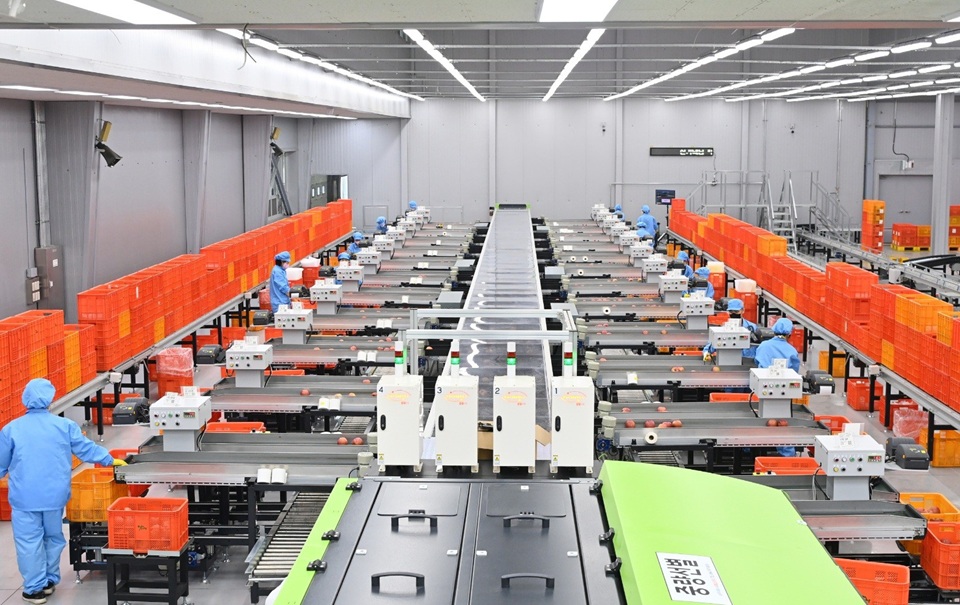
▲ 경상북도는 2023년부터 도내에서 운영 중인 133개 농산물산지유통센터 가운데 16개를 대상으로 규모화와 스마트화를 추진하고 있다. 사진은 스마트 APC 내부. Gyeongsangbuk-do Province since 2023 has promoted the expansion and smartification of 16 of the province's 133 agricultural product distribution centers. (Gyeongsangbuk-do Province - 경상북도)

실제로 경북 성주군의 참외를 취급하는 APC에서는 고성능 카메라와 센서를 활용해 품질, 크기, 과피 결함 등을 자동으로 판별하고 등급별로 분류하는 AI 자동 선별 시스템을 도입했다. 그 결과 시간당 선별 물량이 20~30% 증가하고 노동력은 50% 이상 절감된 것으로 나타났다.

For example, an APC handling chamoe (Korean melons) in Seongju-gun County adopted an AI sorting system using high-performance cameras and sensors to automatically detect quality, size and peel defects for classification by grade.

This setup raised hourly sorting volume 20%-30% and more than halved labor.

올해 하반기에는 쌀, 원예농산물, 축산물 등의 재배 면적을 파악하는 위성을 발사해 농산물 수급 예측 체계도 개선할 예정이다. 소비자가 농산물 가격을 비교할 수 있는 애플리케이션도 5개 지역에서 시범 출시한다.

In the second half of the year, a satellite will be launched to determine areas cultivating rice and horticultural and livestock products to improve the system for forecasting farm supply and demand.

A pilot program in five regions will also allow consumers to compare agricultural product prices.

정부는 비대면 원격진료, 행정 키오스크, 쓰레기 분리수거, 버스정류장 등에도 AI를 도입해 농촌 주민의 삶의 질을 높인다. 농촌 환경 개선하는 AI 서비스를 제공하는 '스마트 농촌생활권'을 2030년까지 100곳 이상 조성할 계획이다.

To raise the quality of life for rural residents, AI will be adopted in non-contact telemedicine, administrative kiosks, waste sorting and bus stops.

Over 100 "smart rural living zones" will be installed by 2030 to provide AI services to improve the rural environment.

산업 생태계의 지속 가능성을 위해 오는 2030년까지 유망 스타트업 3000개사를 육성하고, 농업 데이터 활용 체계를 구축해 관련 산업의 기반을 공고히 할 방침이다.

For the sustainability of the industrial ecosystem, public support will go toward 3,000 promising startups by 2030 and a utilization system for agricultural data will firm up the foundation of related industries.

송미령 농림축산식품부 장관은 "인공지능은 농업·농촌의 생존과 미래 경쟁력을 결정짓는 핵심 기반"이라며 "농업·농촌 전반에서 인공지능을 체감할 수 있는 변화를 만들어 가겠다"고 말했다.

"AI is a core basis for determining the survival and future competitiveness of agriculture and rural areas," Minister of Agriculture, Food and Rural Affairs Song Mi-ryung said.

"We will make changes to allow people to experience AI in agriculture and rural communities."

배경훈 부총리 겸 과학기술정보통신부 장관은 "농업·농촌의 AI 전환을 활발히 지원하겠다" 며 "농업 AI 기술력 증진은 물론 체계적인 데이터 활용 등 다양한 분야에서 농식품부, 농진청과 적극 협력해 나가겠다"고 밝혔다.

"We will actively support the AI transformation in agriculture and rural areas," Deputy Prime Minister and Minister of Science and ICT Bae Kyunghoon added.

"We will actively cooperate with the Ministry of Agriculture, Food and Rural Affairs and the Rural Development Administration in tasks like improvement of agricultural AI capacity and systematic data use."

샤를 오두앙 기자 caudouin@korea.kr
By Charles Audouin, caudouin@korea.kr

"수명과 안전성 모두 잡았다"···KAIST·고려대, 리튬금속 배터리 상용화 핵심 기술 개발 - Joint team develops longer lasting, safer lithium metal battery

"수명과 안전성 모두 잡았다"···KAIST·고려대, 리튬금속 배터리 상용화 핵심 기술 개발 - Joint team develops longer lasting, safer lithium metal battery

 ▲ 타오펜 첨가 전해질로 덴드라이트 성장을 억제한 리튬금속 배터리(인공지능 생성 이미지). This artificial intelligence-generated image shows how a lithium metal battery can suppress dendrite growth through the addition of thiophene to an electrolyte. (Korea Advanced Institute of Science and Technology - 한국과학기술원)

한국 연구진이 차세대 배터리로 주목받는 리튬금속 배터리(Lithium Metal battery)의 상용화를 앞당길 핵심 기술을 개발했다.

A research team has developed a core technology to accelerate the commercial application of the state-of-the-art lithium-metal batteries.

한국과학기술원(KAIST)은 고려대학교와 함께 배터리 수명과 안전성을 동시에 잡는 '지능형 보호막' 기술을 구현했다고 24일 밝혔다.

The Korea Advanced Institute of Science and Technology (KAIST) on Feb. 24 said its joint project with Korea University developed an "intelligent protective film" that raises both battery lifespan and safety.

리튬금속 배터리는 현재 사용되는 리튬이온(Lithium-ion) 배터리보다 더 많은 전기를 저장할 수 있어 전기차 주행거리를 크게 늘릴 수 있다.

A lithium-metal battery can store more power than the more common lithium-ion model, meaning electric vehicles powered by the former can expect to travel longer distances.

하지만 충전과 방전을 반복하는 과정에서 나뭇가지 모양으로 자라나는 '덴드라이트' 현상이 상용화의 가장 큰 걸림돌로 지적됐다. 이 결정체가 배터리 내부를 찌르면 배터리 수명이 짧아지고 내부 단락이나 화재 위험으로 이어질 수 있기 때문이다.

The repeated charging and recharging of a lithium-metal battery leads to the formation of dendrites, structures shaped like tree branches that pose the biggest obstacle to the battery's commercial use. Dendrites can shorten lifespan and cause internal short circuits or a fire hazard if they pierce a battery's interior.

연구팀은 해결책으로 배터리 속 액체 물질인 전해질에 '티오펜(Thiophene)' 물질을 첨가했다. 그 결과 전극 표면에 리튬 이온이 안정적으로 이동할 수 있도록 돕는 '지능형 보호막'이 형성됐다.

To resolve this issue, the researchers added the substance thiophene to the electrolyte, the liquid substance inside the battery, to form an intelligent protective layer allowing lithium ions to move stably across the electrode surface.

이 보호막은 상황에 따라 구조가 스스로 조절되는 특징이 있다. 교통량에 따라 차선을 조정하는 스마트 교통 시스템처럼, 리튬 이온이 움직일 때마다 보호막 안의 전하 분포가 유연하게 변해 가장 효율적인 통로를 만들어준다. 이 때문에 빠르게 충전하는 환경에서도 덴드라이트 생성을 효과적으로 억제하고, 배터리 수명을 크게 늘릴 수 있다.

This layer has a self-regulating structure depending on the situation. Similar to a smart transit system that adjusts lanes based on traffic volume, the charge distribution in the layer changes flexibly as lithium ions move for the most efficient passage, suppressing dendrite formation even in environments with uber-fast shifts to greatly extend battery life.

연구팀은 배터리 내부 관찰로 높은 전류 조건에서도 리튬이 표면에 고르게 쌓였다가 제거되고 안정적으로 작동하는 것을 확인했다.

By observing the battery's interior, the team confirmed that lithium accumulated evenly on the surface and was removed even under high currents, enabling stable operation.

이 기술은 특정 배터리에만 적용되는 것이 아니라 현재 사용되는 전기차 배터리 시스템 전반에 폭넓게 적용 가능하다. 초장거리 전기차는 물론 도심 항공 모빌리티, 차세대 고밀도 에너지 저장 장치 등 다양한 미래 산업 분야에 활용될 것으로 기대된다.

This technology can be applied not only to certain batteries but all used in electric vehicles. Its use in future industries includes electric vehicles that drive long-range distances, urban air mobility and next-generation devices for high-density energy storage.

연구진은 "이번 성과가 고속 충전과 긴 수명을 동시에 구현하는 차세대 전기차 배터리의 핵심 기반 기술이 될 것"이라고 밝혔다.

The team said, "This achievement will become the core foundational technology for next-generation electric vehicle batteries with high-speed charging and a long life."

이번 연구는 재료·에너지 분야 학술지 '인포맷(InfoMat)'에 지난 2일 게재됐다. This research was published on Feb. 2 in the China-based materials and energy journal InfoMat.

샤를 오두앙 기자 caudouin@korea.kr

High-tech home keeps indoor conditions stable in desert climates - 건설연, 중동 사막기후 맞춤형 모듈러 건축기술 개발

High-tech home keeps indoor conditions stable in desert climates - 건설연, 중동 사막기후 맞춤형 모듈러 건축기술 개발

 This is a model house built with passive modular construction technology. 패시브 모듈형 기술이 적용된 주택 (Korea Institute of Civil Engineering and Building Technology - 한국건설기술연구원)

A new construction technology maintains comfortable indoor conditions in desert regions with wide swings in daily temperatures and frequent sandstorms. 사막의 극심한 일교차와 강한 태양열, 잦은 모래바람에도 실내 환경을 쾌적하게 유지할 수 있게 됐다.

The Korea Institute of Civil Engineering and Building Technology (KICT) on Sept. 15 said its "passive desert-customized modular construction technology" allows energy self-sufficiency even in the hot and dry desert climate of the Middle East.

한국건설기술연구원(건설연)은 고온 건조한 중동 사막 기후에서도 에너지 자립이 가능하도록 특화된 '패시브 사막형 모듈러 건축 기술'의 개발에 성공했다고 15일 밝혔다.

KICT applied a design that blocks heat from coming through windows and prevents overheating of the roof. A high level of airtightness also ensures stable air quality indoors even if ventilation is difficult because of frequent sandstorms.

건설연에 따르면 창을 통해 들어오는 열기를 차단하고 옥상의 과열을 방지하는 설계가 적용됐다. 잦은 모래폭풍으로 환기가 어려운 상황에서도 실내 공기 질을 안정적으로 유지할 수 있도록 높은 수준의 기밀성능(気密性能)도 확보했다.

A technical and economic feasibility analysis found that the new technology saves up to 37% in the costs for structural, fire-resistant and exterior-finishing construction and shortens the overall construction period 9%.

기술 경제성을 분석한 결과 기존 강재 모듈러 공동주택 대비 구조, 내화, 외장 마감 공사비가 약 37% 절감되고 전체 공사 기간도 약 9% 단축되는 것으로 확인됐다.

"This technology is thanks to our technological prowess creating a high-performing house that is energy self-sufficient even in extreme desert climates," KICT President Park Sunkyu said. "This bridgehead for domestic builders to enter the Mideastern construction market is also the basis for us to lead the world in green construction technology."

박선규 한국건설기술연구원 원장은 "이번 기술은 극한의 사막 기후에서도 에너지 자립이 가능한 고성능 주택을 우리 기술력으로 구현한 성과"라며 "중동 건축 시장 진출의 교두보이자 글로벌 친환경 건축 기술을 선도하는 기반이 될 것"이라고 말했다.

By Koh Hyunjeong, hjkoh@korea.kr
고현정 기자 hjkoh@korea.kr

농업의 미래를 이끄는 만나CEA - Manna CEA, Leading the Future of Agriculture

농업의 미래를 이끄는 만나CEA - Manna CEA, Leading the Future of Agriculture

만나CEA는 기술로 농업의 미래를 이끈다. 환경제어시스템과 아쿠아포닉스 농법을 결합해 환경에 따라 좌지우지되는 농업의 불확실성을 보완하고, 나아가 기후위기로 인한 세계 식량 부족을 해결할 대안을 제시하고 있다.

Manna CEA leads the future of agriculture. Combining an environmental control system and aquaponics agriculture, the company’s technology offsets the uncertainties faced by conventional farming, including vulnerability to weather, and presents alternatives that address world food shortages caused by climate change.

 환경제어시스템과 아쿠아포닉스 농법 기술로 농업의 미래를 이끄는 만나 CEA의 전경 Manna CEA’s futuristic complex in Jincheon implements the company’s environmental control system and aquaponics agriculture. © MANNA CEA

만나CEA 전태병 대표는 충북 진천에서 40종의 작물을 재배하는 30대 젊은 농부다. 그러나 전 대표는 작물에 직접 물과 비료를 주지 않는다. 그가 귀농을 희망하는 사람들을 교육하고, 인터뷰하는 동안에도 제어시스템이 알아서 작물을 관리하기 때문이다. 또 농업용수 부족과 비룟값 인상, 인력 부족을 걱정하지 않는다. 이유는 간단하다. 그가 농부인 동시에 공학자이기 때문이다.

The CEO of Manna CEA, Jeon Tae-byeong, is a young farmer in his 30s who currently grows 40 different crops in Jincheon, a county in North Chungcheong Province. He doesn’t need to water or fertilize the crops himself because his control system manages them on its own while he is training aspiring farmers or giving interviews. Jeon is neither worried about water or labor shortages nor about rising fertilizer prices, because he is an engineer as much as a farmer.

세상에 이로운 기술의 탄생 - TECHNOLOGY THAT BENEFITS THE WORLD

전태병 대표는 창업 전까지 농사를 지어본 적 없었다. 그는 한국과학기술원(KAIST)에서 기계공학을 전공했고, 졸업을 앞두고 로스쿨 진학을 고민하고 있었다. 그러던 중 전 대표는 우연히 적정기술을 알게 되었다. 적정기술이란, 기술이 사용되는 공동체의 정치‧문화‧환경적 측면을 고려해 만들어진 기술을 말한다.

Before he started Manna CEA, Jeon had no farming experience. After majoring in mechanical engineering at KAIST, he was considering law school, when he happened to come across what is known as “appropriate technology.” This refers to technology that is developed with consideration for the political, cultural, and environmental aspects of the community where it will be used.

“적정기술에 대해 들었을 때, 평소 관심을 두었던 농업과 전공 분야인 시스템제어기술을 접목한다면, 세상에 이로운 기술이 탄생할 거라고 생각했습니다. 기후 변화, 농촌 인구 고령화 등 농업 위기에 대한 우려가 계속되고 있었거든요. 재배 환경을 시스템으로 관리할 수 있다면, 농촌이 안고 있는 복합적인 문제를 해결할 수 있을 것 같았죠.”

“When I heard about appropriate technology, I thought to myself that if I could combine my longstanding interest in agriculture with system control technology, which was my focus at university, I might be able to develop a technology that could benefit the world. I was constantly worried about the farming crisis, induced by climate change and the aging of the farming population. If the cultivating environment could be managed by a system, then the complex problems plaguing the agricultural community might be solvable.”

전 대표는 먼저 대학교 창업보육센터에 회사를 세웠다. 그리고 유기농법 전문가, 환경제어기술 전문가 등을 만나 농사 환경에 맞는 제어시스템을 개발하기 시작했다. 센서를 통해 온실 속 온도, 습도, 빛, 이산화탄소의 양과 암모니아, 칼륨, pH 농도 등 식물에 필요한 다량원소와 미량원소를 디지털 데이터로 수집‧관리하는 시스템이다. 그는 시스템 개발에 성공한다면, 세계 어느 지역에서든 최적화된 생장 환경을 구현할 수 있을 거라고 믿었다.

Jeon first established his company at KAIST’s Technology Business Incubation Center. He met with experts in organic farming and environmental control technology, among others, with the aim of developing a system capable of controlling agricultural environments. The system would use sensors to measure greenhouse temperature, humidity, light, and CO₂levels, as well as concentrations of the macro elements and micronutrients needed by plants. It would also collect and manage all of this information as digital data. Jeon believed that if he could succeed in developing such a system, it would be possible to implement the optimum growth environment anywhere in the world.

회사 이름도 지었다. 만나 CEA의 ‘만나’는 성경에 나오는 단어로 ‘하늘에서 내린 음식’을 뜻하며, CEA는 환경제어농법(Controlled Environment Agriculture)의 약자다. 하늘에서 음식을 내려주듯 농업기술을 발전시켜 전 세계에 굶은 사람이 없게 하겠다는 뜻이 담겼다.

He also came up with his company’s name by combining Manna, the miraculous food sent from heaven in the Bible, and CEA, an acronym for “controlled environment agriculture.” This demonstrates Jeon’s desire that no one in the world go hungry and that this can be achieved by developing agricultural technology that provides food as if by divine intervention.

‘핵융합 신규 프로젝트’ 추진···인공태양 기술 확보 - Nuclear fusion project gets KRW 1.2T to harness 'artificial sun'

‘핵융합 신규 프로젝트’ 추진···인공태양 기술 확보 - Nuclear fusion project gets KRW 1.2T to harness 'artificial sun'

 ▲ 대전 유성구 한국핵융합에너지연구원에 구축된 한국형 초전도 핵융합 연구장치 ‘KSTAR(케이스타)’의 모습. The KSTAR is a magnetic fusion device for superconducting nuclear fusion at the Korea Institute of Fusion Energy (KFE) in Daejeon's Yuseong-gu District. (KFE - 한국핵융합에너지연구원)

 한국 정부가 ‘인공태양’으로 불리는 핵융합 기술 개발 및 인프라 구축을 위해 1조2000억 원 규모의 신규 프로젝트를 추진한다. A new government project worth KRW 1.2 trillion seeks to develop energy from nuclear fusion, dubbed the "artificial sun," and related infrastructure.

과학기술정보통신부(과기정통부)는 이종호 과기정통부 장관 주재로 제20차 국가핵융합위원회를 열어 이같은 내용을 담은 ‘핵융합 에너지 실현 가속화 전략’을 의결했다고 22일 밝혔다.

The Ministry of Science and ICT on July 22 at a meeting of the National Nuclear Fusion Committee chaired by Minister Lee Jong Ho said this in announcing a resolution on a strategy to speed up the harnessing of fusion energy.

핵융합은 태양에서 에너지가 만들어지는 원리를 모방해 중수소와 삼중수소의 핵융합 반응으로 에너지를 생산하는 기술이다. 탄소를 배출하지 않을뿐만 아니라 고준위 방폐물을 발생시키지 않아 탈탄소 시대의 핵심 에너지원으로 주목받고 있다.

Nuclear fusion imitates the principle behind the sun's energy output, which comes through the fusion reaction of deuterium and tritium. This emits no carbon and does not produce high-level radioactive waste, so it is attracting attention as a core energy source in the decarbonization era.

정부는 핵융합 에너지 상용화에 주도적으로 참여할 역량을 확보해 탈탄소 시대 에너지 안보·주권의 핵심축으로 도약한다는 정책 목표를 설정했다. 이를 위해 기술 혁신, 산업화, 생태계 등의 3가지 기본 방향을 중심으로 민관 협력을 통한 핵융합 기술 혁신, 핵융합 에너지 산업화 기반 구축, 핵융합 에너지 혁신 생태계 조성이라는 3대 전략과 9가지 핵심 과제를 수립했다.

The policy goal is to secure the ability to take the early lead in the commercial application of such energy and take a major step forward as a linchpin of energy security and sovereignty in the carbon-free era.

To this end, the committee set three major strategies and nine main tasks focused on the three fundamental directions of technological innovation, industrialization and ecosystem including fusion technology innovation via private-public cooperation, setup of the basis for industrialization of such energy and creation of an innovation ecosystem in the field.

민관 협력과 관련해서는 민간의 우수한 엔지니어링 역량과 공공의 핵융합 기술 역량을 결합하는 ‘퓨전 엔지니어링 혁신 프로젝트’를 추진하고 디버터 및 증식블랭킷 등 핵심 기술 개발을 지원한다.

In private-public cooperation, the government will promote a project for innovating fusion engineering that combines the outstanding capacities of private engineering and public fusion technology. It will also support the development of core know-how such as diverters and breeding blankets.

인공지능(AI) 기술을 활용해 핵융합로의 표준 운영 기술을 개발하는 한편 사물인터넷(IoT) 기반의 핵융합로 운전상태 모니터링 기술을 개발해 극한 환경에서 운전하는 핵융합로의 상태를 원격 진단하는 기술도 개발한다.

To remotely diagnose fusion plants in extreme environments, artificial intelligence will be used to develop the standard operating technology for the reactors and technology to monitor their operations based on the Internet of Things.

이와 함께 한국형 초전도 핵융합 연구장치인 ‘케이스타(KSTAR)’ 설계·건설 경험으로 확보한 기술력과 ‘국제핵융합실험로(ITER)’ 등 국제 공동연구를 통해 쌓은 해외 네트워크를 활용해 해외 연구장치 건설 사업 수주를 지원한다.

By utilizing the technology gained through the planning and construction of the KSTAR, a domestic research device for superconducting fusion, and a network abroad formed through joint global research such as the International Thermonuclear Experimental Reactor (ITER), the ministry will support overseas construction projects for research devices.

핵융합 인력수요 확대 대응을 위한 전문인력 확보·양성을 위해서는 대학의 핵융합 전공 및 과목을 신설·확대하고, ITER와 연계한 교육훈련 프로그램을 확충한다. 해외 우수연구자 유치와 정착을 위해 인건비 제도개선, 유치기관에 대한 인센티브 제공 등도 적극 검토할 계획이다.

Domestic universities will either launch or expand nuclear fusion majors and subjects and boost education training linked to ITER. This is to secure and develop highly skilled personnel to respond to rising demand for workers in the sector. Improvements to the personnel cost system will be studied and incentives for host institutions will seek to attract outstanding foreign researchers and have them settle here.

이 장관은 “핵융합에너지는 에너지 문제 및 전력수요 증가 문제의 해결책으로 미래에는 핵융합에너지 기술을 확보한 나라만이 세계 에너지 시장을 주도할 수 있다” 면서 “민관 협력 중심의 연구개발 전환과 핵융합 생태계 강화를 통해 핵융합에너지를 조기에 확보해 에너지 패권 경쟁에서 주도권을 확보하겠다”고 강조했다.

"Fusion energy is a solution to energy problems and rising demand for electricity, so only countries with the technology to create such energy can lead the global energy market," Minister Lee said. "We will secure leadership in the competition for energy hegemony by acquiring fusion energy in the early stage by shifting the focus of research and development to public-private cooperation and reinforcing the nuclear fusion ecosystem."

박혜리 기자 hrhr@korea.kr
By Park Hye Ri, hrhr@korea.kr